
Indoor days go more smoothly when the activity fits the room you actually have. A small apartment, a shared living room and a kitchen table can all hold worthwhile play. You do not need a separate playroom, a printer or a new bin of supplies.
These thirty ideas keep materials and cleanup visible. Choose a table activity when floor space is tight, or a gentle movement story when sitting has worn thin. If children share a room, give each a clear patch of working space before introducing a shared project.
Build a three-part indoor rhythm
Begin with something you do together, leave room for a familiar activity with you nearby, then change position or pace. For example, tell a short toy story, offer paper for drawing its setting and finish with a soft-parcel delivery. This is a flexible sequence, not a schedule every family must follow.
Keep furniture climbing, unstable blanket structures and small loose pieces out of a setup meant to be easy. A quieter activity may still need close help, while an older child may independently draw for a while. Choose by the task, not just by whether the child is sitting.
30 activities to choose from
Time and age labels are planning suggestions. Use the adaptations and provide the adult help your child needs.
1. Sock match detectives
What you need: Clean socks and a laundry basket. Cost: Use what you have.
Tip six socks onto the floor and ask your child to reunite the pairs. Make a small parking space for each finished pair instead of insisting on perfectly folded bundles. Once the obvious matches are done, choose a mystery sock and describe its clues without naming its color. Stop while it still feels like a game; the whole laundry pile can wait.
Make it fit: For older kids, sort by owner and fold pairs. For younger kids, begin with two very different pairs.
Adult help: Adult nearby.
2. The one-box neighborhood
What you need: An empty cereal box, paper and crayons. Cost: Use what you have.
Open a clean box flat and draw a road across the inside. Add one place your family uses, such as a library, grocery store or bus stop. Your child decides what belongs next door and moves a finger along the route. Let the neighborhood change as the story changes; a convincing map is less useful than a place they want to return to.
Make it fit: Offer one building to a younger child. Older kids can add addresses, a legend and delivery routes.
Adult help: Adult nearby.
3. Find five soft things
What you need: Objects already in the room. Cost: Use what you have.
Choose one property, such as soft, blue or round. Ask your child to point to five examples without climbing or opening cupboards. Compare two of the discoveries: which would fit in a pocket, make a noise or be useful outside? A pointing hunt avoids the extra job of carrying a houseful of objects back to their homes.
Make it fit: Let younger kids find two things. Older kids can explain an object that nearly fits but does not.
Adult help: Adult nearby.
4. Draw the missing half
What you need: Paper and crayons. Cost: Use what you have.
Fold a sheet in half and draw one side of an imaginary creature, a house or a leaf. Unfold it and invite your child to finish the other side. Matching is optional: a tiny wing beside a huge wing can become the beginning of a story. Swap roles after the first picture so the child gets to set the challenge.
Make it fit: Younger kids can add marks anywhere. Older kids can try symmetry or deliberately invent an asymmetrical creature.
Adult help: Adult nearby.
5. Stuffed-animal check-in
What you need: Two stuffed animals and a towel. Cost: Use what you have.
Set up a pretend arrival desk for two stuffed animals. Ask what each visitor needs: a rest, a blanket, directions or someone to listen. Your child makes a space for one guest and chooses a job for you. Keep medical play gentle and imaginary; there is no need for real medicines, bandages around bodies or pretend diagnoses.
Make it fit: A younger child can tuck in one guest. Older kids can make a guest book and room signs.
Adult help: Adult nearby.
6. The disappearing drawing
What you need: Paper and a pencil with eraser. Cost: Use what you have.
Draw a simple scene with five obvious objects. Ask your child to look, then turn away while you erase or lightly cover one object. Reveal the page and let them name what changed. Take turns changing the scene. Because everything stays on one page, this is a useful choice when you have energy for a game but not for cleanup.
Make it fit: For younger kids, change one big shape. Older kids can change two details or the position of an object.
Adult help: Adult nearby.
7. Book picture expedition
What you need: A picture book you already own. Cost: Use what you have.
Open a familiar book and ignore the printed story for one round. Look for something tiny, someone who might be surprised and a place you would like to visit. Give your child time to explain what they see instead of turning it into a right-answer quiz. On the next page, let them choose the question.
Make it fit: Nonreaders can point. Confident readers can find a sentence that supports their interpretation.
Adult help: Adult nearby.

8. Paper-strip road
What you need: Scrap paper and chunky crayons. Cost: Use what you have.
Lay broad strips of paper end to end on a table to make a road. Draw one bridge, one parking area and one place to turn around. Move a fingertip or a large toy vehicle along the route. Build another section only when the current road has a story. Keep floor routes out of walking paths and skip tape if the surface might mark.
Make it fit: Younger kids can follow the line. Older kids can create detours and road signs with a clear rule.
Adult help: Adult nearby.
9. Laundry-basket deliveries
What you need: A lightweight basket and soft toys. Cost: Use what you have.
Put three soft toys into an empty basket and invent three delivery addresses around one room. Your child walks the basket to each address and hands over the correct parcel. Keep loads light and routes clear; no one rides inside the basket. Finish by delivering the toys to their real storage spot so the game resets itself.
Make it fit: Use picture clues for younger kids. Older kids can remember a three-stop delivery order.
Adult help: Adult nearby.
10. Fold a family menu
What you need: One sheet of paper and crayons. Cost: Use what you have.
Fold a sheet into a little menu and add a drawing of one breakfast, one lunch and one dinner. Invite your child to open an imaginary restaurant for stuffed animals or family members. The menu can feature ordinary food or wildly invented meals. Take one order, pretend to prepare it and switch jobs before the game becomes a demand for real cooking.
Make it fit: A younger child can draw one meal. Older kids can add prices and calculate a pretend bill.
Adult help: Adult nearby.
11. The kitchen-tool sketch
What you need: A safe kitchen utensil, paper and pencil. Cost: Use what you have.
Place a wooden spoon or whisk on the table and look at its shapes together. Draw the handle first, then the part that does the work. Accuracy is optional; the useful challenge is noticing something familiar closely. After the drawing, invent a second job for the object in a fictional world. Put the real utensil away before choosing another.
Make it fit: Younger kids can trace a large spoon with help. Older kids can draw it from a second angle.
Adult help: Adult nearby.
12. Sort a pretend store
What you need: Large play food, clean empty containers or drawings. Cost: Use what you have.
Choose six safe objects for a small store and arrange them in two sections. Your child decides what the sections mean: breakfast and dinner, tall and short, or things that belong together. Visit as a customer with one simple request. Avoid turning every choice into a lesson; unusual organizing systems are part of the game.
Make it fit: Use just three objects for younger kids. Older kids can make labels and a restocking list.
Adult help: Adult nearby.
13. The scribble rescue
What you need: Paper and crayons. Cost: Use what you have.
Make a loose scribble and pass the page to your child. Ask what the scribble could become when you add a few lines: a sleepy cat, a storm or a ridiculous vehicle. There is no best transformation. Add one detail at a time, or take separate pages if sharing a single picture leads to arguments. End by giving the creation a title.
Make it fit: Younger kids can choose what you add. Older kids can turn the same scribble into two different ideas.
Adult help: Adult nearby.
14. Design a tiny museum
What you need: Three safe household objects and paper. Cost: Use what you have.
Choose three objects that tell a story about a made-up explorer. Place them on a shelf or table and make a label for each. Invite one visitor to tour the exhibition and ask a question. Keep the collection deliberately small so there is time for storytelling rather than a full-room treasure hunt and a long reset afterward.
Make it fit: Draw labels for nonreaders. Older kids can write a curator’s introduction and an admission ticket.
Adult help: Adult nearby.
15. Shadow shapes on paper
What you need: Paper, pencil and daylight from a window. Cost: Use what you have.
Place a large safe object where its shadow falls on a sheet of paper. Trace the shadow, move the object and compare the new outline. Use daylight rather than a hot lamp or an elaborate lighting setup. If the sun disappears, turn the first outline into an imaginary creature and continue drawing; the activity does not depend on perfect weather.
Make it fit: Younger kids can color an outline. Older kids can return later and compare where the shadow falls.
Adult help: Adult nearby.

16. The giant paper doodle
What you need: Reused wrapping paper or several sheets and crayons. Cost: Use what you have.
Cover a small patch of table with the blank side of paper and agree on one shared world: a park, an underwater town or a space diner. Each person adds something without correcting another person’s work. Leave a border around someone else’s drawing if they want their own space. Roll the paper away when interest fades instead of demanding a finished mural.
Make it fit: Give younger kids a separate corner. Older kids can invent a key connecting everyone’s contributions.
Adult help: Adult nearby.
17. Paper cup architecture
What you need: Large paper cups or lightweight plastic tumblers. Cost: Use what you have.
Put a small set of empty cups on the table and build a structure with a wide base. See whether a bridge or doorway can remain standing. Keep towers below face height and use lightweight materials. When the cups fall, ask which piece you would change rather than treating the collapse as failure. Nest the cups together at the end.
Make it fit: Younger kids can make a row and stack two. Older kids can work within a six-cup limit.
Adult help: Adult nearby.
18. Make a comic in four boxes
What you need: Paper and pencil. Cost: Use what you have.
Fold paper into four panels. In the first, introduce a character who wants something; in the second, add a problem; in the third, try a solution; in the fourth, show what happens. Stick figures and speech bubbles are enough. If writing slows the fun, take dictation for your child while they draw the action.
Make it fit: Younger kids can narrate one panel. Older kids can make a wordless comic another person can understand.
Adult help: Adult nearby.
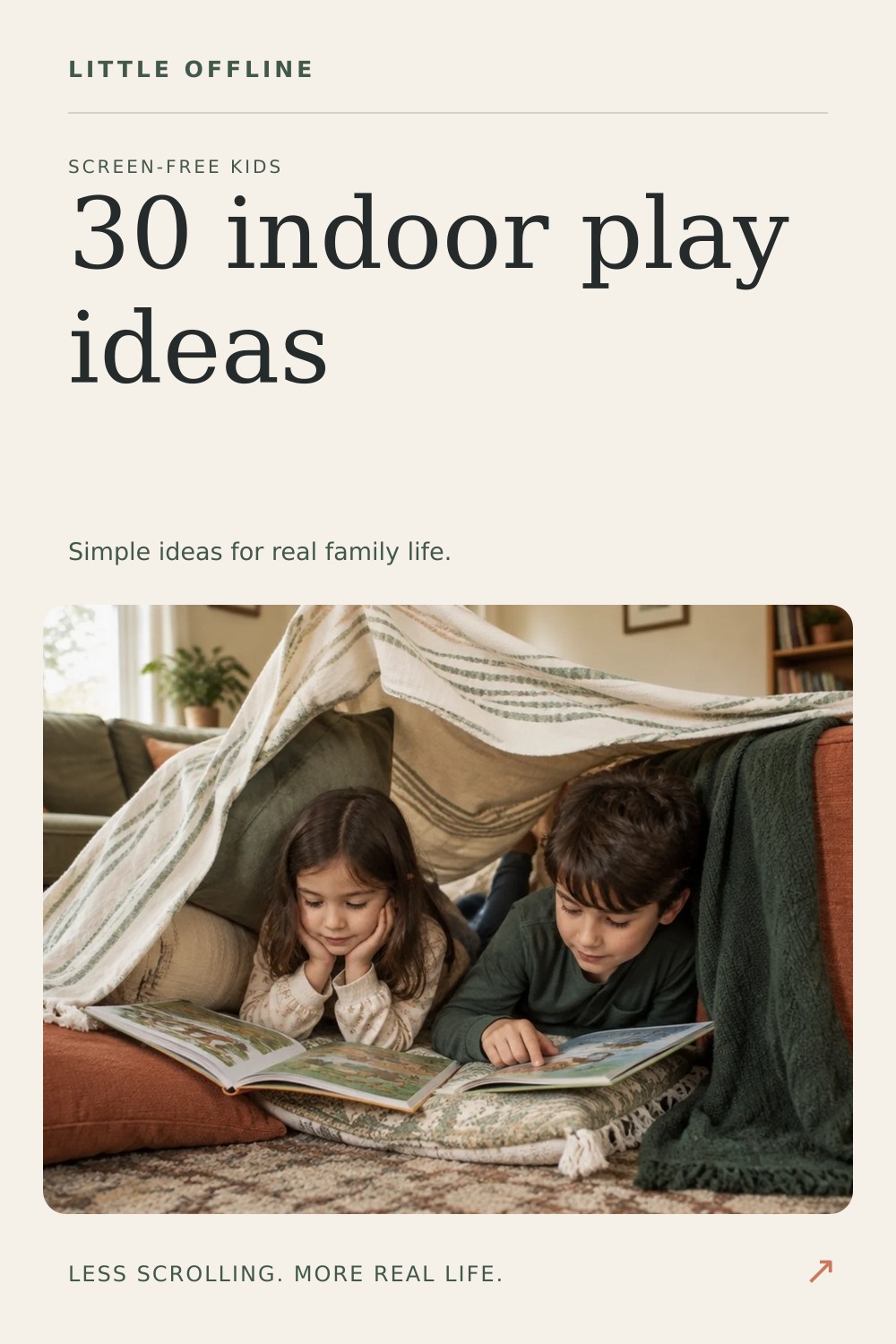
19. Build a reading island
What you need: A floor cushion, blanket and two books. Cost: Use what you have.
Create one comfortable spot on the floor with a cushion and a flat blanket. Let your child choose two books and decide which comes first. Keep the setup open and easy to see rather than draping fabric over unstable furniture. The island can be used for picture looking, reading aloud or quietly telling a story from memory.
Make it fit: Sit beside a younger child. Older kids can add a handwritten reading sign and choose a chapter stopping point.
Adult help: Adult nearby.
20. The alphabet of our house
What you need: Paper, pencil and objects you can see. Cost: Use what you have.
Choose a letter and find something in view that starts with its sound. Sketch it or write its name on a page. Continue with another letter instead of making the entire alphabet a requirement. When a difficult letter appears, invent a silly thing the house could contain. Point to objects rather than opening private drawers or collecting fragile belongings.
Make it fit: Use colors instead of letters for younger kids. Older kids can work backward or use a theme.
Adult help: Adult nearby.
21. Make a family newspaper
What you need: One folded sheet, pencil and a family conversation. Cost: Use what you have.
Ask for one real piece of household news: a repaired bike, a new library book or a funny breakfast moment. Add a headline and a drawing. Include a pretend weather report only if it is clearly part of the game. Let your child read the finished page aloud, then save it or recycle it without making publication a daily obligation.
Make it fit: Younger kids can dictate a headline. Older kids can interview someone and separate news from opinion.
Adult help: Adult nearby.
22. The upside-down artist
What you need: Paper, crayons and a simple object. Cost: Use what you have.
Draw an ordinary object as though it were upside down, or turn an existing doodle and add new details. Let the change suggest a different scene: a tree might become a chandelier or a boat might become a hat. The page moves, not the child; there is no need for upside-down positions or climbing to get a new view.
Make it fit: Younger kids can turn and describe the page. Older kids can make three transformations from one drawing.
Adult help: Adult nearby.

23. Tabletop story theater
What you need: A folded paper backdrop and two large toys. Cost: Use what you have.
Stand a folded sheet on the table as a backdrop and place two characters in front. Give one character a small problem, such as losing a hat or missing a bus. Ask the other character to help in a surprising way. Keep the first performance short enough that you can switch director and actor roles without anyone losing interest.
Make it fit: Young children can choose a character’s voice. Older kids can write a three-scene script.
Adult help: Adult nearby.
24. The pattern parade
What you need: Large blocks or drawn shapes. Cost: Use what you have.
Arrange three large blocks in a repeating pattern and ask what might come next. Your child can follow your rule or invent another and explain it. If physical pieces cause frustration, draw the pattern instead. Keep small construction pieces away from younger siblings and children who mouth objects, even when an older child is doing the activity.
Make it fit: Begin with two alternating colors. Older kids can create a pattern with more than one changing feature.
Adult help: Adult nearby.
25. Design a pet for a planet
What you need: Paper and crayons. Cost: Use what you have.
Invent a planet with one unusual feature, such as permanent rain or very tall trees. Draw an animal that could feel at home there. Ask where it sleeps, what it carries and how it greets a friend. There is no need to make the design scientifically correct; make the imagined needs and choices clear enough for someone else to follow.
Make it fit: Younger kids can choose one feature. Older kids can label adaptations and sketch a habitat.
Adult help: Adult nearby.
26. Three clues, one object
What you need: Nothing beyond the room around you. Cost: Use what you have.
Secretly choose an object everyone can see. Give three clues about its use, shape or location without pointing to it. Let your child guess after each clue, then trade roles. Choose objects well within reach of sight and skip anything that encourages climbing. If the game becomes too hard, add a generous final clue rather than protecting your secret.
Make it fit: Use familiar objects for younger kids. Older kids can avoid mentioning color or the first letter.
Adult help: Adult nearby.
27. The cozy weather report
What you need: Paper and crayons or just your voices. Cost: Use what you have.
Look out a window and describe what the weather is doing right now. Your child presents a short report to an imaginary audience and suggests one activity that fits the conditions. Include what you can actually observe rather than predicting storms or temperatures. An indoor report can end with a drawing of clothing you might choose for a later walk.
Make it fit: Younger kids can name sun, clouds or rain. Older kids can compare two observations taken later.
Adult help: Adult nearby.
28. Map the room from above
What you need: Paper and pencil. Cost: Use what you have.
Imagine floating safely above the room like a camera and draw where the door, window and largest furniture would appear. Choose one familiar route and trace it with a finger. The map does not need accurate scale. Keep this as a drawing exercise; no one needs to climb to see the room from above or move heavy furniture.
Make it fit: Younger kids can place a drawn bed and door. Older kids can add a key and estimate distances.
Adult help: Adult nearby.
29. Sort the family bookshelf
What you need: A small stack of books. Cost: Use what you have.
Take down only five or six books and choose a new way to group them: animal stories, nighttime stories, books to read together or books to browse alone. Let your child explain their categories. Return the books to an accessible shelf rather than reorganizing an entire room. If the activity turns into reading, follow that interest and finish the reset later.
Make it fit: Younger kids can select a favorite cover. Older kids can make shelf labels and a lending record.
Adult help: Adult nearby.
30. The tiny repair studio
What you need: Scrap paper, a torn paper drawing and washable glue stick. Cost: Use what you have.
Use a discarded drawing with a small tear as your repair project. Show how to bring the edges together and attach a paper patch with a glue stick. Decorate the repair or leave it visible as part of the story. Keep real broken toys, batteries, glass and electrical items out of this pretend studio; those need adult handling.
Make it fit: Younger kids can press the patch down. Older kids can design a stronger paper hinge.
Adult help: Adult nearby.
When the room starts to feel crowded
Reduce the number of materials before adding another activity. Put away one game and bring out one different category: drawing after building, conversation after a noisy game, or a short walk if conditions permit. For siblings who keep taking each other’s supplies, parallel versions can work better than a single shared project.
Useful for these ideas
Gather a few things. Then start.
We may earn a commission through shopping links, at no extra cost to you. These are editorial suggestions, not claims of hands-on product testing. Details.
Make & create
Removable paper tape
Useful for paper constructions, floor routes and simple sorting games.
Check before you buy
Test a hidden surface first; remove gently. No tape across walkways or on skin.
Questions parents ask
What works in a small apartment?
A pocket sketchbook, paper museum, story theater or book-picture hunt needs only a table corner or seat.
How do I avoid a huge cleanup?
Set out a small first batch of materials, name the storage spot before play and stop adding supplies when the current idea is working.
Save a little inspiration
Keep this idea for later.
Save the guide to your family activities board.
Save to Pinterest

