
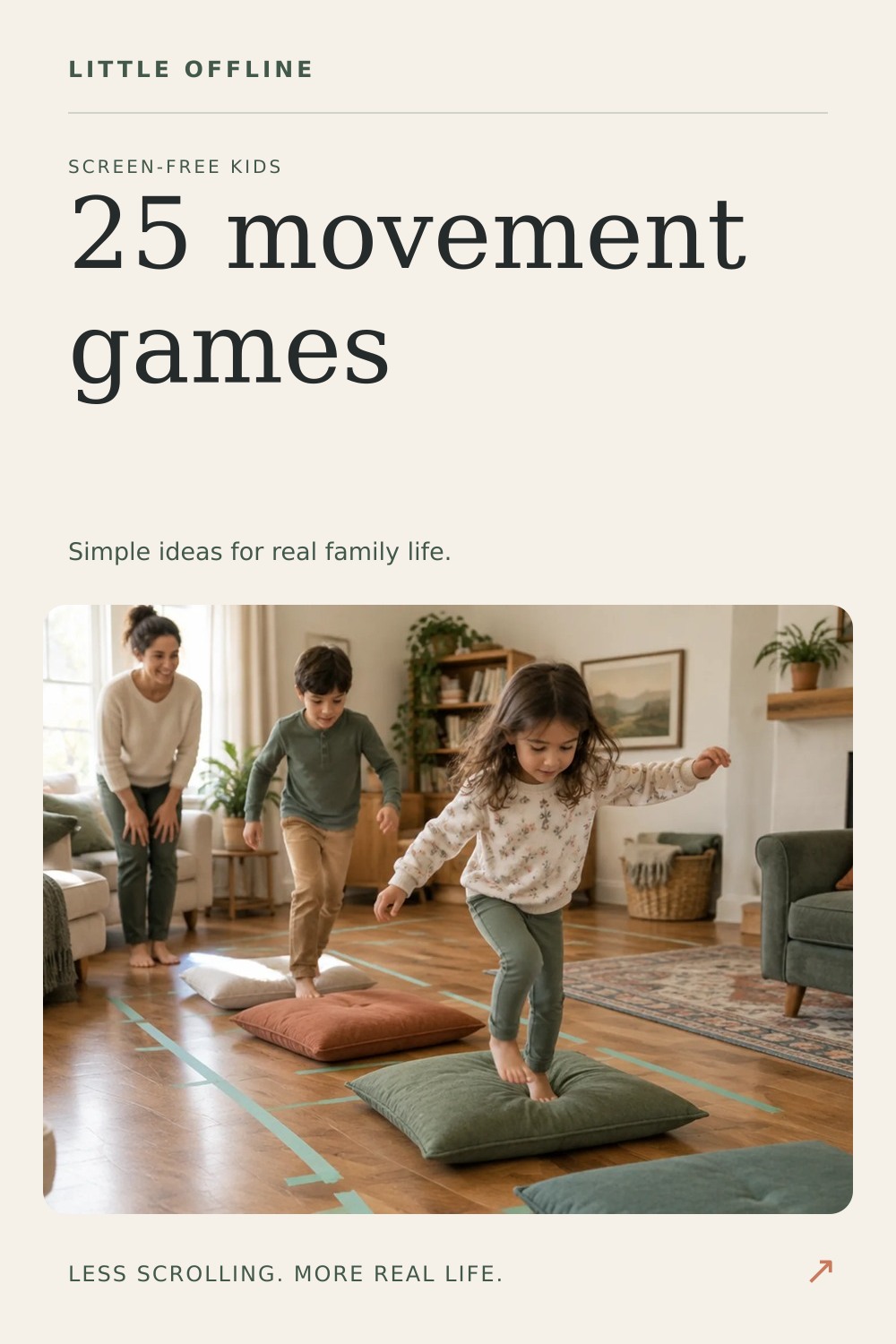
When a child wants to move, another seated worksheet may be the wrong fit. You can change the pace without turning the living room into a gym. The twenty-five ideas here use small stories and ordinary space to make movement easy to begin.
“High-energy” describes the situation, not a diagnosis. These are general play ideas, not exercise prescriptions or treatment. Adults check the space and adapt to the child’s comfort, mobility and any individual guidance they already follow.
Check the real room before adding a pretend challenge
Clear the route, check the floor and remove breakables. Keep movement away from stairs, doors, sharp corners and pets who may be underfoot. The story can contain rivers and mountains while the actual movement remains ordinary walking or reaching.
Give everyone permission to change or skip a movement. A seated version, a smaller gesture or narrating the action can preserve participation without demanding that bodies move in the same way.
25 activities to choose from
Time and age labels are planning suggestions. Use the adaptations and provide the adult help your child needs.
1. Sock snowball targets
What you need: Rolled socks and a laundry basket. Cost: Use what you have.
Place a basket close by and gently toss rolled socks into it from a clear floor space. Give each person a comfortable distance rather than one standard line. Collect the socks together between rounds. Keep throws below head height and aim only at the basket, never at people, pets or fragile objects.
Make it fit: Use underhand drops for younger kids. Older kids can choose a shared target total.
Adult help: Adult checks space and supervises movement.
2. Follow the gentle leader
What you need: A clear patch of floor. Cost: Use what you have.
Choose one leader to demonstrate three comfortable movements, such as reaching up, marching in place and making small arm circles. Everyone may adapt or skip a movement. Change leaders after one short sequence so the game does not become an exercise class. Leave enough room that arms cannot hit furniture or another person.
Make it fit: Offer a seated version. Older kids can remember a longer sequence.
Adult help: Adult checks space and supervises movement.
3. Animal walks, small version
What you need: A clear, nonslip floor. Cost: Use what you have.
Choose a few low-risk animal-inspired moves: stretch tall like a giraffe, take tiny penguin steps or gently flap like a bird. Avoid headstands, climbing and fast crawling near furniture. Let your child choose how their body moves rather than demanding a particular position. Stop for discomfort, dizziness or fatigue.
Make it fit: Use seated animal gestures when preferred. Older kids can invent a controlled movement and name it.
Adult help: Adult checks space and supervises movement.
4. Step-over river
What you need: Two flat strips of paper. Cost: Use what you have.
Put two paper strips on nonslip flooring to suggest a narrow river. Step across without jumping, then walk around and try from the other side. Keep the gap comfortably small and remove slipping paper if necessary. The pretend story can change while the movement stays simple: a river becomes a sidewalk crack or a moon path.
Make it fit: A younger child can hold an adult’s hand. Older kids can add a story route.
Adult help: Adult checks space and supervises movement.
5. Mirror moves
What you need: A partner and clear space. Cost: Use what you have.
Stand or sit facing each other. One person moves slowly while the other mirrors them: lift a hand, turn a palm or make a gentle shoulder movement. Swap after a short round. Speed is not the goal. If copying feels frustrating, take turns making different movements and call it a conversation instead.
Make it fit: Younger kids can copy one hand. Older kids can try switching leaders without announcing it.
Adult help: Adult checks space and supervises movement.
6. Floor-is-a-map walk
What you need: Paper landmarks or verbal directions. Cost: Use what you have.
Choose three safe spots in a room as a library, park and home. Walk between them according to a simple pretend errand. Stay on the floor; furniture is not part of the route. Add a story problem, such as returning a book before heading home, only if it makes the game more interesting.
Make it fit: Use one destination for younger kids. Older kids can plan an efficient three-stop route.
Adult help: Adult checks space and supervises movement.

7. Paper-plate stepping route
What you need: Flat paper circles on a nonslip surface. Cost: Use what you have.
Arrange paper circles along a short clear route and step beside them or tap them with a toe. Test that the paper will not slip; remove it if it does. Children can choose their own stride and keep both feet on the floor. There is no need for jumping, balancing on cushions or increasing difficulty every round.
Make it fit: Younger kids can follow an adult. Older kids can choose a color sequence.
Adult help: Adult checks space and supervises movement.
8. The silent marching band
What you need: Your bodies and optional paper instruments. Cost: Use what you have.
Pretend to play an instrument while marching gently around a clear space. Try an almost-silent round, then one with soft vocal sounds. Stop at an agreed signal and switch instruments. Keep the route away from stairs and doorways. A seated band with hand movements works just as well when walking is not a good fit.
Make it fit: Younger kids can copy a drum motion. Older kids can conduct a short sequence.
Adult help: Adult checks space and supervises movement.
9. Stretch to the story
What you need: A short invented story. Cost: Use what you have.
Tell a story with comfortable movements inside it: the tree reaches up, the flower opens and the turtle settles down. Offer movements as choices, not physical instructions to push farther. Pause after a few lines and let your child add the next scene. Finish with an ordinary seated moment so the activity has a clear ending.
Make it fit: Use tiny hand motions for younger or seated participants. Older kids can narrate.
Adult help: Adult checks space and supervises movement.
10. Deliver the soft parcel
What you need: A soft toy and clear route. Cost: Use what you have.
Carry one stuffed animal from one safe spot to another using two hands. On the next trip, imagine that it is a sleeping dragon and walk quietly. Keep the real movement straightforward and avoid carrying objects on heads or balancing on furniture. Let the story provide the challenge rather than adding physical risk.
Make it fit: Younger kids can use a shorter route. Older kids can remember delivery instructions.
Adult help: Adult checks space and supervises movement.
11. Five moves, one pattern
What you need: Nothing. Cost: Use what you have.
Choose five comfortable actions, such as clap softly, tap knees, reach forward, march twice and wave. Practice together, then let your child change one action. Keep the sequence short enough to enjoy. Anyone can watch, lead verbally or use a seated adaptation, so participating does not depend on matching another person’s movements.
Make it fit: Younger kids can repeat two moves. Older kids can create an A-B-A pattern.
Adult help: Adult checks space and supervises movement.
12. The slow-motion mission
What you need: A clear floor area. Cost: Use what you have.
Pretend you are astronauts carrying an imaginary cup across the room in slow motion. Walk at a comfortable pace and exaggerate only the storytelling, not precarious body positions. At the destination, describe what the imaginary cup contains. The game can last a single trip, making it useful between seated activities.
Make it fit: A seated version uses slow hand movements. Older kids can narrate the mission.
Adult help: Adult checks space and supervises movement.

13. Stand-up story choices
What you need: Two safe spots or two hand gestures. Cost: Use what you have.
Tell a story with two choices: forest or beach, umbrella or boots. Participants move to the chosen spot or signal with a hand. Continue the story using one choice, or combine both if the group is split. Keep movement small and routes clear; this is a way to participate, not an elimination game.
Make it fit: Younger kids can point. Older kids can offer the next pair of choices.
Adult help: Adult checks space and supervises movement.
14. The paper-airplane ground game
What you need: One paper airplane made with adult help. Cost: Use what you have.
Place a paper airplane on a table as a story prop, then move your arms gently as its wings while narrating a flight. Walk a short route for takeoff and landing instead of throwing planes around a crowded room. If you choose real paper flights later, use an empty safe area and never aim at faces.
Make it fit: Younger kids can choose the destination. Older kids can make a flight announcement.
Adult help: Adult checks space and supervises movement.
15. Count-the-steps explorer
What you need: A safe clear room. Cost: Use what you have.
Choose two familiar points and count comfortable steps between them. Try a second route without rushing and compare the counts. No result needs to match anyone else’s because stride length differs. Keep the game away from stairs, thresholds and breakables. Finish by choosing the easiest route for carrying a book.
Make it fit: Younger kids can count with help. Older kids can estimate before walking.
Adult help: Adult checks space and supervises movement.
16. Dance a drawing
What you need: Paper, crayons and clear space. Cost: Use what you have.
Draw three simple marks such as a wave, a dot and a spiral. Invent a comfortable movement for each, then point to the marks in different orders. Music is optional; this can be a quiet game. Keep turns gentle and skip spinning if it is uncomfortable. A drawing remains useful when everyone wants to sit down again.
Make it fit: Younger kids can choose one mark. Older kids can compose a short sequence.
Adult help: Adult checks space and supervises movement.
17. The tidy-up relay without racing
What you need: Three soft objects and their storage spot. Cost: Use what you have.
Move three objects back to where they belong, one at a time. Each trip gets a pretend role: mail carrier, librarian or careful museum worker. Avoid timing, competition and carrying heavy loads. The small number makes the task finishable, and the game ends once the three objects are home.
Make it fit: Younger kids can carry one item with help. Older kids can choose a practical route.
Adult help: Adult checks space and supervises movement.
18. Wall-free balance practice
What you need: A clear nonslip floor and adult nearby. Cost: Use what you have.
Stand with both feet comfortably on the floor and slowly shift weight from one foot to the other. Add a gentle reach if comfortable, or stay seated and reach instead. Do not use furniture as an obstacle or attempt challenging balances. Treat this as exploring movement, not measuring ability or fixing a physical issue.
Make it fit: Younger kids can copy a gentle sway. Older kids can narrate an imaginary boat ride.
Adult help: Adult checks space and supervises movement.

19. The giant invisible paintbrush
What you need: Your arms and clear space. Cost: Use what you have.
Pretend your hand is a paintbrush and draw a large shape in the air. Another person guesses the shape or adds something to the imaginary picture. Keep arm movements within a comfortable range. You can create a whole scene without leaving your seat, making this a useful option in a small room.
Make it fit: Younger kids can make circles. Older kids can draw an object in several connected parts.
Adult help: Adult checks space and supervises movement.
20. Move the story forward
What you need: A partner. Cost: Use what you have.
Start a story and pause for a small action that fits it: wave to a neighbor, tiptoe past a sleeping pretend bear or stretch to see a cloud. Use safe, comfortable movements and let the child decline any action. Resume the story after each pause so the activity has an engaging reason to move.
Make it fit: Younger kids can choose the next action. Older kids can narrate for the group.
Adult help: Adult checks space and supervises movement.
21. The color-corner walk
What you need: Three colored drawings and clear floor space. Cost: Use what you have.
Place three colored papers where everyone can see them, not underfoot. Name a color and walk to the nearby safe spot. Change the game by adding a story rather than increasing speed. Keep the route clear and allow pointing or seated gestures for anyone who prefers them.
Make it fit: Younger kids can follow a visible color. Older kids can remember a two-color order.
Adult help: Adult checks space and supervises movement.
22. Two-minute pretend parade
What you need: A clear path and optional soft toy. Cost: Use what you have.
Choose a theme such as library animals or tiny gardeners. Walk one loop while carrying a soft toy or miming a job. Announce a short ending and park the imaginary parade. There is no need for costumes, music or a cleanup-heavy setup; a shared story is enough to make ordinary walking feel different.
Make it fit: Younger kids can follow. Older kids can introduce each pretend participant.
Adult help: Adult checks space and supervises movement.
23. Reach, name, return
What you need: Safe objects already visible. Cost: Use what you have.
Name an object in view and reach an arm gently in its direction without leaving your spot. Return to a relaxed position, then choose another. Do not stretch toward actual high shelves or climb to retrieve anything. The game combines looking and moving while keeping materials and movement contained.
Make it fit: Younger kids can point. Older kids can give descriptive clues before the reach.
Adult help: Adult checks space and supervises movement.
24. The cushion-free obstacle story
What you need: Nothing beyond a clear floor. Cost: Use what you have.
Imagine obstacles instead of building them: a narrow path, a sleepy dragon and a puddle. Walk around pretend hazards with comfortable steps while an adult checks the real space. Avoid furniture climbing, jumping from heights and slippery surfaces. Children can invent the story while adults keep the physical route ordinary.
Make it fit: Younger kids can hold a hand. Older kids can design and narrate the imaginary route.
Adult help: Adult checks space and supervises movement.
25. Pass the invisible balloon
What you need: A partner or small group. Cost: Use what you have.
Pretend to pass an enormous light balloon using slow hands. Change its imagined size, temperature or weight and see how everyone’s gestures change. Use no real balloon, avoiding popped pieces and cleanup. Let a child narrate instead of moving if that is more comfortable. End by releasing the imaginary balloon into a made-up story.
Make it fit: Younger kids can copy a simple pass. Older kids can mime different objects without words.
Adult help: Adult checks space and supervises movement.
Use a short round, then notice what is needed
A movement break does not have to exhaust a child. Try one small round and see whether they want more movement, a drink, a quieter game or ordinary rest. Avoid using activity as punishment or as a requirement to earn a screen.
When you need a calm ending, choose a visible final action such as returning the socks to the basket or parking the pretend delivery vehicle. This makes the transition clearer than stopping a fast game without warning.
Useful for these ideas
Gather a few things. Then start.
We may earn a commission through shopping links, at no extra cost to you. These are editorial suggestions, not claims of hands-on product testing. Details.
Outside
Sidewalk chalk
For outdoor paths, drawing games and temporary play spaces.
Check before you buy
Choose a safe permitted surface away from traffic; follow product instructions.
Questions parents ask
Can these work in a small home?
Yes. Mirror movements, air drawing, seated gestures and slow story actions need little floor space.
Do we need music or equipment?
No. Many ideas use only voices and comfortable movement. Soft socks and paper are optional supplies for a few activities.
Save a little inspiration
Keep this idea for later.
Save the guide to your family activities board.
Save to Pinterest

