
The challenge on a long drive is not finding one magical activity. It is having a few different ways to pass time without continually unpacking, explaining and picking things up. A practical plan makes the next choice easy for the adults as well as the children.
Start with your route and the number of available adults. A trip with an adult passenger has different options from a drive with one caregiver behind the wheel. Be honest about that difference before packing the bag. Activities that depend on constant adult assistance belong at stops or in a different travel setup.
Use four modes across the journey
Think in modes rather than fixed hourly slots: look outside, play together, do something quietly and rest. The order can change. A child happily watching the view does not need an activity introduced because a schedule says it is time. Save the kit for the moment it becomes useful.
Before departure, name the broad plan: “We will drive, take a stop and have a few things to do along the way.” Avoid promising exact arrival times or a particular mood. Road conditions and children’s needs can change the schedule.
12 activities to choose from
Time and age labels are planning suggestions. Use the adaptations and provide the adult help your child needs.
1. Window color search
What you need: The view outside. Cost: Use what you have.
Choose one color and look for it in signs, buildings or passing vehicles. Count together or simply point things out; the driver should not look away from the road or join a scoring contest. Keep the search cooperative and stop if looking sideways feels uncomfortable. Nothing needs to be held, retrieved or spread across a lap.
Make it fit: Younger kids can find one color. Older kids can choose an uncommon shade or a category.
Adult help: Adult passenger helps; driver stays focused.
2. Three-clue destination
What you need: Your voices. Cost: Use what you have.
One passenger chooses a familiar place and offers three clues about what happens there. Everyone guesses, then a different passenger takes a turn. Keep clues generous and allow a child to pass. Use pretend or already-known destinations rather than sharing private travel details with strangers in public spaces.
Make it fit: Younger kids can choose familiar places. Older kids can avoid obvious location words.
Adult help: Adult passenger helps; driver stays focused.
3. One-sentence travel story
What you need: Your voices. Cost: Use what you have.
Start with a character who is going somewhere and let each passenger add one sentence. Set a friendly rule such as no frightening surprises if younger children are listening. The story can end after one round; it does not need to fill the entire journey. Drivers can listen without being expected to keep track.
Make it fit: Younger kids can contribute a sound or character. Older kids can add a problem and resolution.
Adult help: Adult passenger helps; driver stays focused.

4. Would-you-rather destinations
What you need: Your voices. Cost: Use what you have.
Offer two playful choices, such as a library in a tree or a bakery on the moon. Ask why only if the child wants to explain. Avoid gross-out or scary choices that make travel harder. After a few rounds, let the child become the question writer and switch to another activity before the format wears out.
Make it fit: Younger kids can point to one of two imagined choices. Older kids can defend a trade-off.
Adult help: Adult passenger helps; driver stays focused.
5. Guess the animal, kindly
What you need: Your voices. Cost: Use what you have.
A passenger chooses an animal and answers a few yes-or-no questions. Agree that unusual or imaginary animals need a clue so the game remains fair. Stop after a handful of questions and reveal the answer if nobody guesses. This works without equipment and can be played quietly in a shared space.
Make it fit: Younger kids can give animal sounds. Older kids can use habitat and movement clues.
Adult help: Adult passenger helps; driver stays focused.
6. The category chain
What you need: Your voices. Cost: Use what you have.
Choose a broad category such as picnic foods or things at a park. Take turns naming one item until someone wants to change the subject. Repetition can be allowed for younger children; elimination is unnecessary. A short friendly round is more useful than a long memory contest that ends in frustration.
Make it fit: Younger kids can repeat and add. Older kids can use alphabetical order.
Adult help: Adult passenger helps; driver stays focused.

7. Road-trip bingo without a board
What you need: A short spoken list. Cost: Use what you have.
Pick three things likely to appear on the route, such as a bridge, a red vehicle and a water tower. Look for them cooperatively and reset the list once found. Avoid rare targets that demand constant searching. The driver stays focused on driving and does not need to verify every sighting.
Make it fit: Younger kids can look for one target. Older kids can choose a themed list.
Adult help: Adult passenger helps; driver stays focused.
8. Travel memory list
What you need: Your voices. Cost: Use what you have.
Start with a simple sentence such as on our trip we brought a book. Each person repeats as much as they comfortably remember and adds an item. Help freely, shorten the list or restart when needed. The game should create silly combinations rather than test who has the best memory.
Make it fit: Younger kids can add without repeating. Older kids can keep an alphabetical list.
Adult help: Adult passenger helps; driver stays focused.
9. The ten-question interview
What you need: Your voices or a prompt card. Cost: Use what you have.
Ask light questions about preferences: the best kind of picnic, a place to visit in a story or a skill someone wants to try. Let every person skip a question. Avoid personal details in crowded public spaces and keep voices low. Save a favorite answer in a journal later if you want.
Make it fit: Younger kids can choose between two options. Older kids can ask a follow-up.
Adult help: Adult passenger helps; driver stays focused.

10. Two truths and a pretend thing
What you need: Your voices. Cost: Use what you have.
Each person shares two ordinary true things and one clearly playful invented thing. Everyone guesses which is pretend. Keep topics harmless and age-appropriate, and do not pressure anyone to share private information. For younger children, make the invented statement obvious so the game is about joining in rather than catching a lie.
Make it fit: Younger kids can use silly statements. Older kids can choose facts about hobbies or familiar places.
Adult help: Adult passenger helps; driver stays focused.
11. The cooperative word ladder
What you need: Your voices. Cost: Use what you have.
Start with a word such as cat and choose a new word connected to it, such as pet, home or blanket. Explain the connection if you want, then continue. Because the links are based on meaning, there is no reading requirement. Change the starting word when the chain stalls instead of turning the game into a vocabulary test.
Make it fit: Younger kids can make any sensible connection. Older kids can avoid repeating a category.
Adult help: Adult passenger helps; driver stays focused.
12. The new ending game
What you need: A familiar story and your voices. Cost: Use what you have.
Choose a story everyone knows and change only the ending. Ask what a character might do differently and let each person suggest a version. No one needs to remember the original word for word. Keep the story gentle if it is close to sleep time or younger passengers are listening.
Make it fit: Younger kids can choose a happy final event. Older kids can change an earlier decision too.
Adult help: Adult passenger helps; driver stays focused.
A realistic journey menu
| Moment | Offer first | If that does not fit |
|---|---|---|
| Just departed | The view and ordinary conversation | A familiar book with passenger help |
| Wants company | A short story or guessing game | A simple category game |
| Wants quiet | A compact drawing or picture activity | Rest with a familiar comfort item |
| Looking down feels uncomfortable | Window spotting or a spoken game | A safe stop and reassessment |
| Everything is rejected | Check comfort and practical needs | Use the next suitable stop rather than adding novelty |
Build a kit that does not need constant repairs
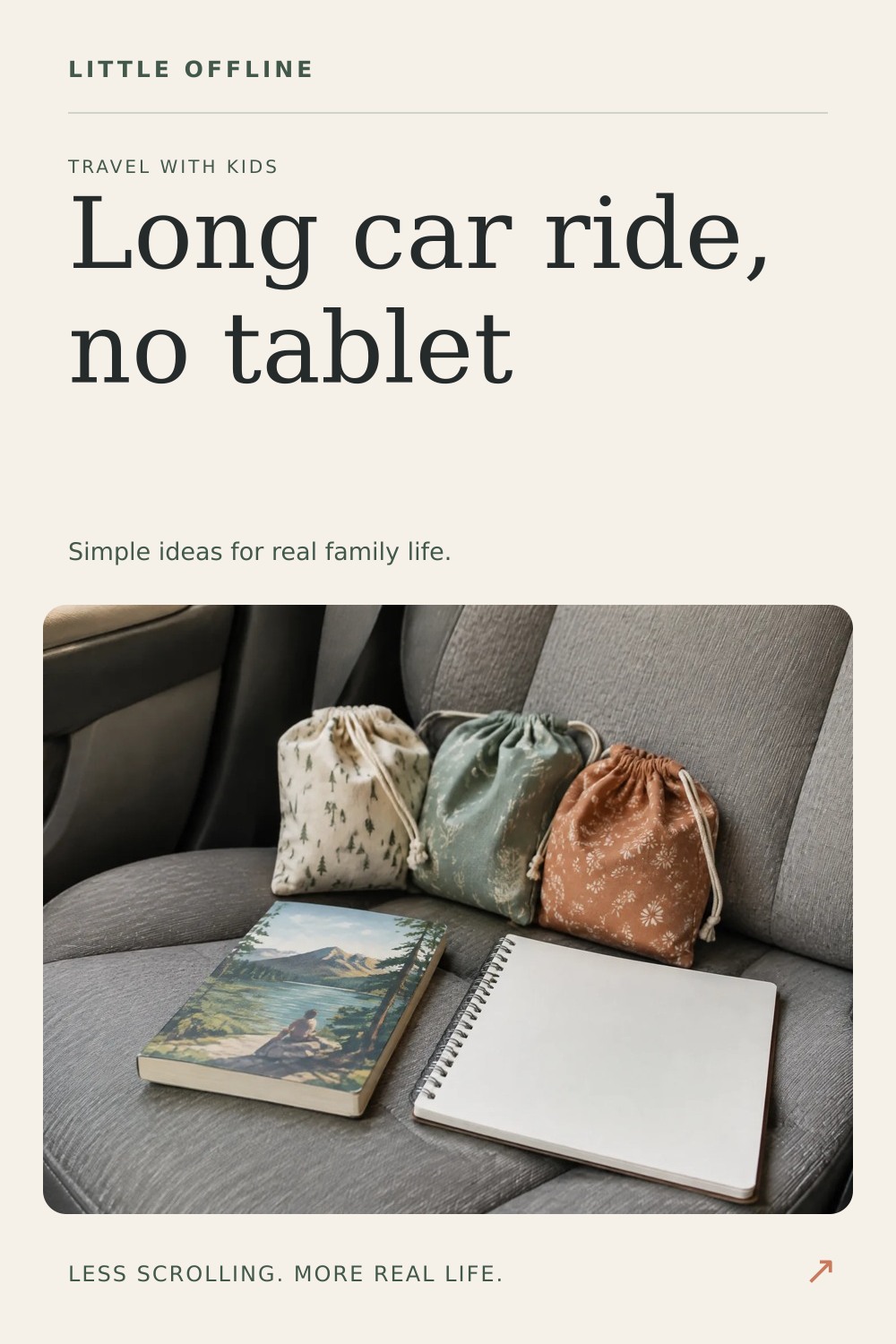
Choose a small notebook, a suitable drawing tool, one familiar book and one optional reusable activity. Put each item back before opening another. Keep supplies light and contained, and avoid accessories that interfere with restraint systems. A driver cannot safely become the person who keeps reaching for lost crayons.
For siblings, duplicate inexpensive essentials where sharing repeatedly causes conflict. A personal notebook can prevent more arguments than an elaborate shared activity. Agree on volume and turn-taking before everyone is tired.
Make stops part of the plan
A stop is not evidence that the activity plan failed. Choose safe places where the family can use the bathroom, eat as appropriate and move comfortably. Keep the stop’s purpose simple. A short break that meets a real need is more useful than rushing through a complicated roadside scavenger hunt.
On arrival, allow a low-demand transition. Children may not want a travel-journal assignment immediately after hours in the car. Save the memory page for later or let a spoken recap be enough.
Useful for these ideas
Gather a few things. Then start.
We may earn a commission through shopping links, at no extra cost to you. These are editorial suggestions, not claims of hands-on product testing. Details.
Make & create
Washable crayons
Drawing, simple maps and paper games. Choose a size your child can comfortably hold.
Check before you buy
Check the age label and washability instructions; keep drawing on paper.
Travel & waiting
A small blank notebook
One notebook can hold a travel journal, a homemade maze and a story game.
Check before you buy
Choose blank or lightly lined pages and a size that fits your pouch.
Questions parents ask
What if my child is used to a tablet in the car?
Discuss the plan before departure, offer familiar alternatives and start with a manageable trip or part of a trip. Avoid surprising the child with a new rule after everyone is already buckled in.
Do I need a new toy for every hour?
No. A few familiar options and repeated spoken games can be easier to manage than constant novelty. Plan around the child and journey rather than a toy-per-hour formula.
Sources & practical references
References checked September 16, 2026. Manufacturer pages describe products; they do not establish suitability for every child or setting.
Save a little inspiration
Keep this idea for later.
Save the guide to your family activities board.
Save to Pinterest

