
A basket can make an agreement visible. It cannot create agreement by itself. If it appears suddenly as a place where only children lose access while adults continue checking messages, the object is likely to become part of the conflict rather than a solution.
Begin with the moment you want to protect: a meal, a short game or a read-aloud. Explain the reason in ordinary language and invite practical concerns before trying it. Families have different accessibility, care and work needs, so a useful plan includes those realities.
Step 1: choose one specific situation
Start with a small shared block rather than a rule covering the whole home. “Phones rest here while we play one round” is easier to understand than “We are becoming a screen-free family.” Choose a time when adults can also participate.
If the family already has a technology agreement, fit the basket into it. Avoid introducing a new physical rule in the middle of an argument. The AAP Family Media Plan can support a broader discussion, but the household still needs its own concrete choices.
Step 2: make adult behavior part of the agreement
Explain genuine exceptions before they happen: an on-call shift, contact from a caregiver or an accessibility need. Say how the person will handle that use and return to the shared activity. Unexplained exceptions can make a supposedly common rule feel arbitrary.
Do not make children responsible for monitoring adults or turn the basket into a surveillance tool. Adults should model the agreement and repair ordinary slips directly: acknowledge the interruption and put the phone back if the use was not needed.

Step 3: choose a practical place
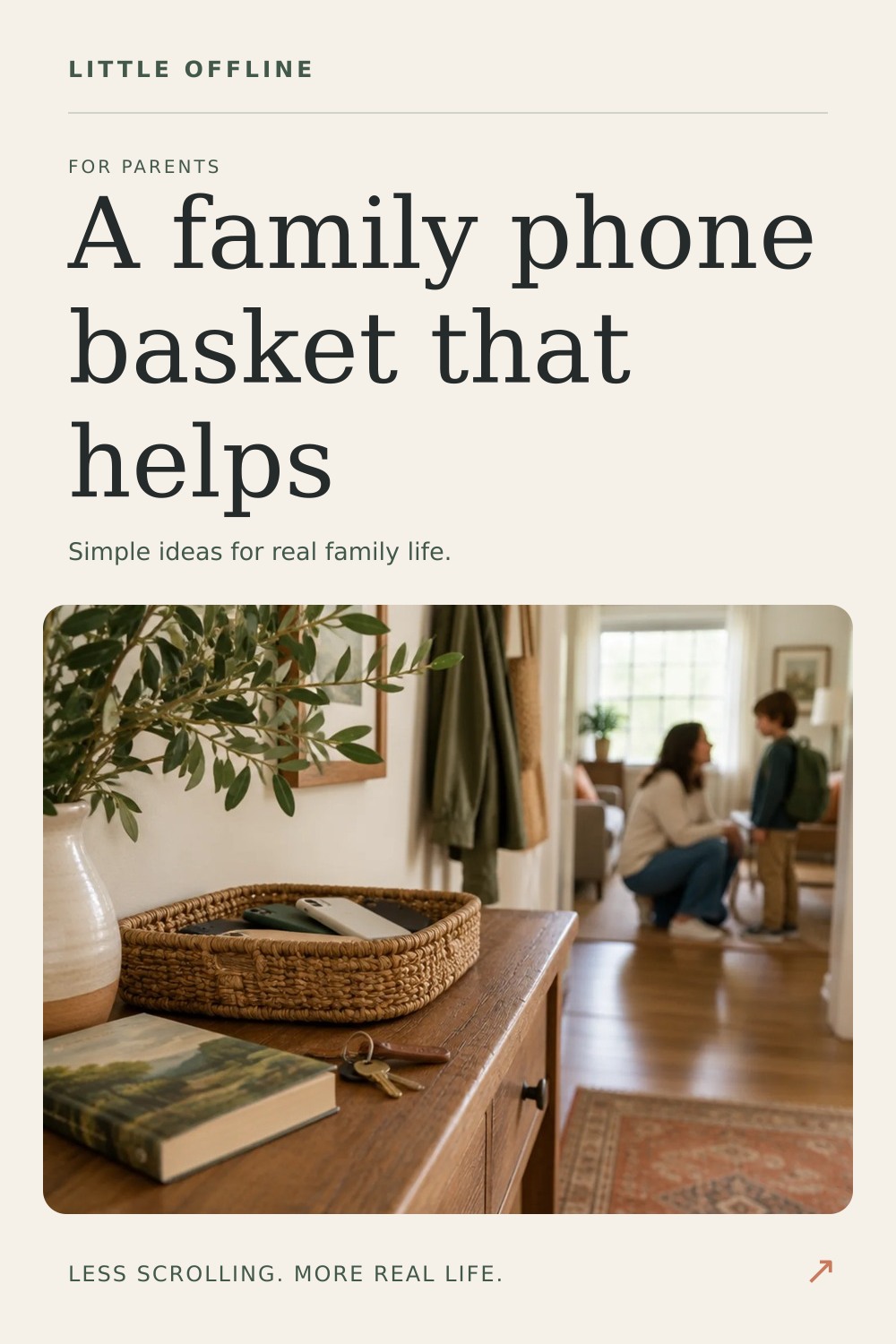
Use an existing container on a safe surface, away from heat, liquids and young children who may handle the devices. Do not use an enclosed basket as a charging setup; follow device charging instructions and keep cords managed safely. The basket can be simply a resting place during the chosen block.
Keep essential communication accessible to the responsible adult. The goal is to remove habitual checking from the immediate activity, not to make it impossible to respond to a real need. Families can use a shelf or designated spot instead of a literal basket.

A simple agreement to discuss
| Question | Example to adapt |
|---|---|
| When do we use it? | During the first part of supper or one shared game |
| Who follows the agreement? | The adults and children participating in that activity |
| What exceptions remain? | Agreed care, work, accessibility or urgent communication needs |
| How does the block end? | At a named point, not whenever one person gets annoyed |
| What happens if it does not work? | We discuss the practical problem and adjust the plan later |

Step 4: put a real activity in the protected time
A phone-free block is easier to begin when people know what they are doing. Serve the meal, open the game or choose the book before asking everyone to put devices aside. Avoid replacing a familiar activity with an indefinite empty period and expecting enthusiasm.
Keep the invitation modest. A short conversation or game can be enough. If family members want different things, choose a small shared start followed by separate offline options rather than forcing the entire evening into one format.
Step 5: respond to resistance without escalating the object
Listen for the actual concern: finishing a message, losing contact with someone, boredom or a rule that feels unequal. You can hold a reasonable household boundary while discussing how it works. Avoid grabbing a device as a surprise or turning the basket into a public punishment.
If conflict is already high, pause the debate and return to the agreement at a calmer time. This article offers a practical routine idea, not a guaranteed solution for persistent family conflict or a substitute for individualized support when needed.
Review the experiment after a few tries
Ask what improved and what was inconvenient. Perhaps the chosen block was too long, the location made urgent contact awkward or adults needed a clearer work exception. Make a specific adjustment rather than abandoning all boundaries or tightening every rule.
Keep the basket only if it helps the agreement. A visual cue is useful when it reduces reminders and makes shared attention easier. If another system works better for the household, use it. The object is not the goal.
A short script you can adapt
“I would like us to have a little time together during supper. Could we put phones in this spot until we finish eating? I need to stay reachable for one care-related call, so I will explain if I have to answer. Afterward we can each return to what we were doing.”
Change the words to fit your family and the actual plan. Avoid making promises about mood, behavior or connection that one routine cannot guarantee. A clear, fair and repeatable agreement is a practical starting point.
Useful for these ideas
Gather a few things. Then start.
We may earn a commission through shopping links, at no extra cost to you. These are editorial suggestions, not claims of hands-on product testing. Details.
Quiet time
A small open storage basket
Holds the few choices in a quiet-time basket or a shared phone parking spot.
Check before you buy
Check accessible contents for every child nearby; keep charging devices ventilated.
Questions parents ask
Should the basket be mandatory for everyone?
Household boundaries are an adult responsibility, but the agreement should be clear, proportionate and honest about exceptions. Adults should model the parts that apply to them.
Do I need a special locking box?
No. This guide uses a simple shared resting place and an agreed time block. Buying a device does not replace the conversation.
Sources & practical references
References checked September 16, 2026. Manufacturer pages describe products; they do not establish suitability for every child or setting.
Save a little inspiration
Keep this idea for later.
Save the guide to your family activities board.
Save to Pinterest

